What is the innovation?
This innovation involves establishing and training professional harvesting teams and equipping them with essential manual harvesting tools including tarpaulins and crates. These teams work closely with smallholder farmers, providing harvesting services that minimise post-harvest losses and improve produce quality. Composed of carefully selected and trained local youth and farmers (some of whom also supply the company) these teams are deployed when the company's field officers report that produce is nearly ready for harvest. Produce that is harvested by the teams can then be prepared for immediate collection.
Key challenges addressed
Goshen, a processor focusing on dried fruit snacks for domestic and export markets, faces significant challenges with high post-harvest loss and low-quality produce. Improper picking practices, such as picking unripe or bruised fruits, lead to up to 35% weight loss during processing. Only around 55% of farmers’ marketable mango harvest is sold to Goshen, primarily because much of the produce fails to meet quality standards due to limited adoption of GAP and inadequate (post-)harvesting equipment, rather than a lack of willingness to supply. Training all farmers in harvesting and handling is costly and yields limited quality control due to uneven adoption, difficult monitoring across dispersed farms, and persistent equipment shortages. Instead, the company trains a select few professional harvesting teams, ensuring timely off-take, better quality control and reduced costs. This approach improves fruit quality and increases the volume of marketable produce sourced from farmers, helping the company reach sourcing targets while making more efficient use of its out-grower farmer base. Additionally, transporting low-quality fruits increases costs per metric ton, highlighting the need for improved fruit quality to enhance profitability and reduce waste.
How it works
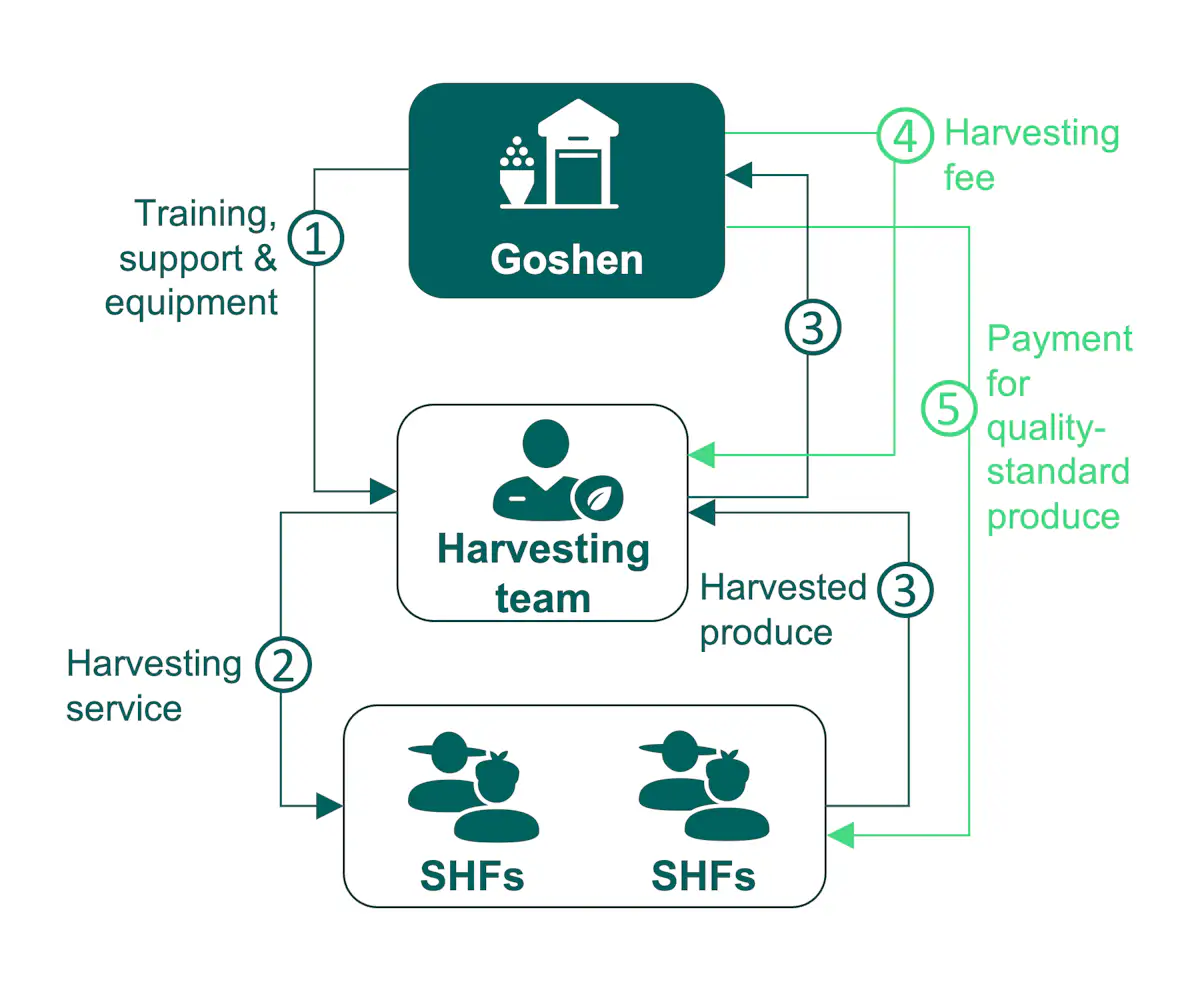
- Local farmers or youth are selected and trained to form professional harvesting teams.
- Teams are deployed when Goshen indicates that the produce is near ready for harvesting and are equipped with tarpaulins and crates at time of harvesting.
- Teams harvest quality produce into crates, minimising bruising and other defects. Harvested produce is collected at farm level 24 hours later and transported to the factory.
- The harvesting team is paid for its services by Goshen.
- Goshen pays farmers (through farmer groups) 1 week after fruit harvesting to allow for proper quality checks.
Tips for replication
Context
- Companies in need of high volumes of quality produce from scattered smallholders
- Challenges with quality and post-harvest loss
- Availability of local farmers and youth to form harvesting teams
Best practices
- Continuous training to keep harvesting teams up-to-date on best practices
- Incentivise teams to maintain high quality standards
- Regular monitoring and evaluation to ensure effectiveness of the harvesting teams
- Close coordination between harvesting teams and field officers to ensure timely harvest
- Invest in harvesting tools, such as tarpaulins & crates
Enabling conditions
- Collaboration with local farmer groups to facilitate the formation of harvesting teams
- Ownership of refrigerated truck enables timely, flexible collection and reduces bruising during longer transport routes
- Adequate logistical support to ensure smooth transportation of harvested produce
Business Case: (expected) Outcomes for Goshen
Cost efficiency
Investing in harvesting teams and basic equipment like crates and tarpaulins is more cost-effective than training all farmers individually in harvesting practices or investing heavily in cold chain infrastructure (since bruised fruit loses quality regardless of cold storage).
Improved quality
Harvesting teams enhance quality by ensuring proper, timely harvest and handling, reducing the risk of bad picking practices that can otherwise cause up to 35% weight loss during processing. Current rejection rates stand at around 10% as a result ofthis approach, with losses shared equally between Goshen and farmers. These improvements give Goshen greater control over quality and help the company consistently meet export standards.
Reduced transport costs
Improved fruit quality because of the harvesting teams and equipment reduces the amount of unusable produce at the factory, lowering transport costs per metric ton and increasing overall profitability.
Impact Case: (expected) Outcomes for Harvesting Teams
Employment opportunities
Creation of professional harvesting teams provides employment opportunities for farmers and local youth. Hiring the teams for their services, provides them with a reliable new source of income, as each harvester harvests on average 350 kg per day and receives between 2-3 KES per kg, for both mango and pineapple.
Impact Case: (expected) Outcomes for Smallholder Farmers
Increased income
Working with professional harvesting teams ensures timely and proper harvesting, aligned with optimal ripeness rather than farmers’ cash needs. This reduces farm-level post-harvest losses from 40% to 15%, improves quality, and eases the burden of finding labour. As a result, more produce meets standards, earns higher prices, and boosts income.
Improved access to market
Farmers receive better support from trained harvesting teams, improving their overall farming practices and selling more and higher quality produce in subsequent seasons. This allows the farmers to more easily meet export standards, providing them with access to international markets.
Outstanding risks & Challenges
- Effective coordination between field officers, harvesting teams and farmers is crucial but can be challenging. Miscommunication or delays in deployment may affect the timing and quality of the harvest, impacting overall efficiency.
- The upfront investment for training and equipping harvesting teams can be significant. While this approach ultimately reduces costs and improves quality, the initial financial investment could put strain on the company's budget.
- Consistently maintaining high-quality standards across all harvesting teams can be difficult. Variability in the performance of different teams may affect the overall quality of the produce and require regular monitoring and adjustments.
- Harvest seasons can vary, affecting the availability and deployment of harvesting teams. This variability can lead to inefficiencies if the company does not effectively manage teams throughout the year.
Data sources & Disclaimer
Information is based on IDH’s Service Delivery Model (SDM) analysis for Goshen, including data from Goshen and 246 mango and 71 pineapple farmers (information is available on our methodology for SDM Analyses and Farmer Surveys). Additionally, interviews with company, agents, and farmers have been held since the start of Technical Assistance (2022) during which the innovation is tested and scaled. A longer time span and additional data are needed to verify and quantify impacts. Farmfit will conduct an end-line assessment of the company’s SDM and farmer livelihoods based on a repeat data collection at company and farm level.
In this article
Stay informed with our smallholder-inclusive business newsletter
Your Insights Hub journey has just started
Sign up here for access to updates - and industry insights and innovation - from the Smallholder Inclusive Business Newsletter.


